Presenting at Lab Innovations

Home » Presenting at Lab Innovations

Nov 14, 2023

On All Hallows Eve 2023, Dr Samantha Pearman-Kanza braved the dark and ghostly motorways to drive up to the Lab Innovations Conference & Exhibition at the NEC in Birmingham. This was her first time attending since 2019, and it was very interesting to see how much this event had grown, and what had changed in the lab sphere.

When Samantha and Nicola attended in 2019 Lab Innovations was predominantly an expo, with a few talks at various junctures. Fast forward 4 years and it now has multiple conference tracks on different areas of lab management and data research, as well as all the usual expo stands that we know and love! Although a word of caution, if you decide to walk round and see every stall and stop paying attention to your surroundings, you might accidentally end up wandering into their sister event Advanced Engineering…if you see F1 cars…you’ve gone too far!

But we digress…back in 2019 when Samantha and Nicola visited, it was to investigate the notion of voice integration into the lab, and specifically ELNs. At the time these areas did not appear very popular, however it is worth noting now that there are many companies working in the area of voice based lab assistants, and the integration of voice into ELNs.

There were a few other notable changes with respect to the current state of lab digitisation. Firstly, the ELN sphere seems to have shifted in recent years, companies are offering full digital platforms where the ELN forms but one part of the research lifecycle. Which is both exciting and important as it demonstrates that there is a need for more than just notebook software, but also dispels the motion that the ELN should do everything whilst serving as a direct replacement for a paper lab notebook, which are somewhat counter productive aspects. There was a much higher prevalence of robotic technology present, and very positively, many more labs seem to be focusing on sustainability as their core values.
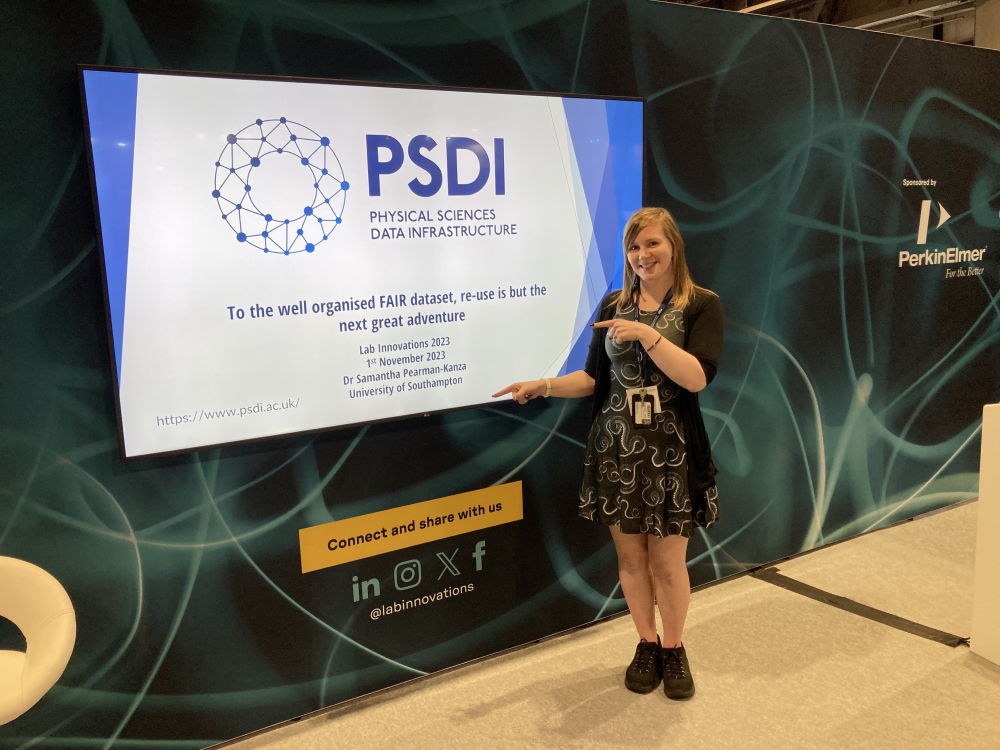
Samantha presented on FAIR data, discussing the notion that making our data FAIR (with respect to adhering to the principles) as opposed to considering the wider considerations of making data (and software) fully re-useable are quite different things. Furthermore, it is very important to consider your research/data/software use case, are you producing research where you want someone to be able to replicate your analysis? Are you producing software you want someone else to be able to use, and what is actually required for them to run it locally themselves? Are you producing data that others need to fully understand in order to re-use it? Or replicate it using your collection methods? Samantha talk discussed these aspects of FAIR through the medium of baking a cake.

We would like to thank all the organisers of Lab Innovations, with a particular shout out to Matthew Partridge who invited Samantha to speak, and is also working with her to produce regular columns in the new Errant Science Lab Horizons Magazine.

You can find the proceedings of Lab Innovations online: https://www.lab-innovations.com/ 
The slides from the PSDI talk are also available: https://doi.org/10.5281/zenodo.10119611

If any of these topics resonate with you and you want to discuss FAIR data, Samantha loves to wax lyrical on this subject so get in touch 🙂

Modern scientific research workflows use a plethora of diverse software tools and file formats. Unfortunately, the file formats that one software tool can export are often incompatible with the formats required for import by another.  Furthermore, the current capabilities for converting data between these different formats are often slow, unclear and error-prone, particularly because data formats vary in their structure and in the amount of information they can represent, making conversion between specific formats complex and sometimes resulting in information loss. PSDI’s Data Conversion Service (DCS) was created to address this challenge, offering researchers a single, trusted place to convert data formats while helping them understand the likely quality and limitations of different conversions.

Where the idea came from

The need for a Data Conversion Service was first identified during research carried out for the PSDI pilot phase at the University of Southampton, which was published in Digital Discovery. This research identified a recurring issue across the physical sciences: researchers were working with data that existed in many different formats, making collaboration and reuse difficult due to a lack of interoperability. Therefore, highlighting that there was a clear need for “data format conversion between different data types in order to facilitate data exchange between different services, and to allow users to collaborate using common formats.”

A key conclusion of this work was that this issue, alongside many other interoperability challenges could best be addressed by identifying existing software that already offers relevant functionality, and creating the infrastructure needed to allow these tools to work together.

Several converters had already been created by the scientific community to address some of these issues, such as Open Babel, although in their current form they were fragmented and offered little insight into conversion quality or potential information loss. Therefore, rather than creating another converter, PSDI’s focus shifted towards making better use of these existing software tools by bringing them together and exposing their capabilities more transparently.

As Dr. Samantha Pearman-Kanza, who was closely involved in shaping the early direction of the service, explains:

Rather than simply creating another conversion tool, the focus was on making the best use of existing software and elevating their offerings. The aim was to help researchers understand what conversions were possible across different scientific data formats , which existing tools could be used, and where the use of these tools for certain conversions might involve compromises in data quality.

From concept to working service

Early ideas explored a search interface that identified possible conversions and directed users to existing conversion software. This quickly evolved into a more researcher-friendly approach: integrating established converters directly into a single service and exposing their options in a consistent way.

Development was carried out by Research Software Engineers Dr. Ray Whorley, Dr. Bryan Gillis and Dr. Don Cruickshank, who initially prototyped the service as a small Python application before expanding it into a fully-fledged web service and suite of downloadable tools.

Reflecting on this evolution, Dr. Whorley says:

The service now incorporates widely used converters such as Open Babel, Atomsk and c2x. Users can upload files, choose input and output formats, apply available conversion options, and download both the converted file and a detailed log. Accessibility has been built in throughout, with users able to customise fonts, sizes and colour schemes.

The Data Conversion Service interface showing format selection, available converters and indicative conversion quality.

Supporting real research workflows

Alongside the web application, the team developed three downloadable tools: a local browser-based version, a command-line tool and a Python library. These are proving particularly valuable for researchers working with sensitive data or automated workflows.

As Dr. Whorley explains:

“The downloadable tools give researchers confidence that their data remains local, and they can be dropped straight into automated workflows.”

This flexibility allows the Data Conversion Service to support everything from quick, one-off conversions to large-scale, repeatable processing pipelines.

Supporting FAIR data and PSDI’s wider ecosystem

Interoperability is a core part of FAIR data practice, and the Data Conversion Service plays a key role in enabling it. Researchers often need to convert the output of one tool into a format that can be used by the next, or to revive legacy data stored in outdated formats. Our service helps reduce the technical barriers to doing both.

Looking ahead

Now that the Data Conversion Service is established, its future direction will be strongly shaped by user feedback. Researchers can report missing formats and conversions directly through the service, and suggestions are already influencing planned enhancements.

Alongside this, there is clear scope for closer integration between the Data Conversion Service and other PSDI tools and services, for example by enabling data transformed through the Data Revival Service (a service which takes scanned handwritten paper lab notebooks and converts them into machine-readable data) to be converted into a wider range of usable formats, or by generating chemical identifiers such as InChI or SMILES from a broader set of input formats for use in discovery services like Cross Data Search.

As Dr. Pearman-Kanza notes:

“The capacity to convert data between different formats is what really unlock reuse across tools, across projects and across disciplines.”

Potential future developments also include support for conversions that require more than one input file, additional conversion tools, chained conversions where no direct route exists, data visualisation, and an API to enable integration with other platforms and services.

A service built with researchers in mind

For the team, seeing the Data Conversion Service grow from an identified need into a live, widely usable tool has been deeply rewarding. The aim is to make data conversion clearer, more transparent and more inclusive, so researchers can spend less time wrestling with formats and software, and more time doing research.

As Dr. Pearman-Kanza puts it:

“If researchers can trust the conversion process and understand its limitations, they are better placed to make informed decisions about how their data can be used. This includes understanding when conversion is appropriate, what can be gained, and what might be lost, which is an important step towards better research practice overall.”


Try the Data Conversion Service

The Data Conversion Service is freely available to use and designed to fit a wide range of research needs, from quick, one-off conversions to integration within automated workflows. Researchers can explore the web-based service, download local tools, and provide feedback directly to help shape future development.

To get started, visit the live service, watch the short introduction video, explore the documentation, or download the tools to use locally within your own workflows.

Explore the Data Conversion Service and start converting your data with confidence.


Loading...