
At the RDA (Research Data Alliance) Plenary 2026, London 6th-8th October, collaborators from PSDI Agnes Jasinska for the DDC (Digital Curation Centre) and Ian Bruno and Cian Dingle of the CCDC (The Cambridge Crystallographic Data Centre) alongside PSDI’s Nicola Knight, co-organised and co-hosted the “Harnessing automation and AI tools to advance data curation and connect digital research infrastructures” Birds-of-a-Feather session.
The aim of the session was to draw on the experiences of our speakers as well as the audience members, we used the session to explore the current uses, challenge and opportunities around automation and AI at different stages of data curation across the disciplines.
A few highlights from the session include:
- Dieuwertje Bloemen (KU Leuven) spoke about automation-supported human FAIR curation of data and metadata at KU Leuven’s institutional literature repository and research data repository, with AI tools being explored to check documentation and generate keywords, but the effort required currently outweighing the benefits.
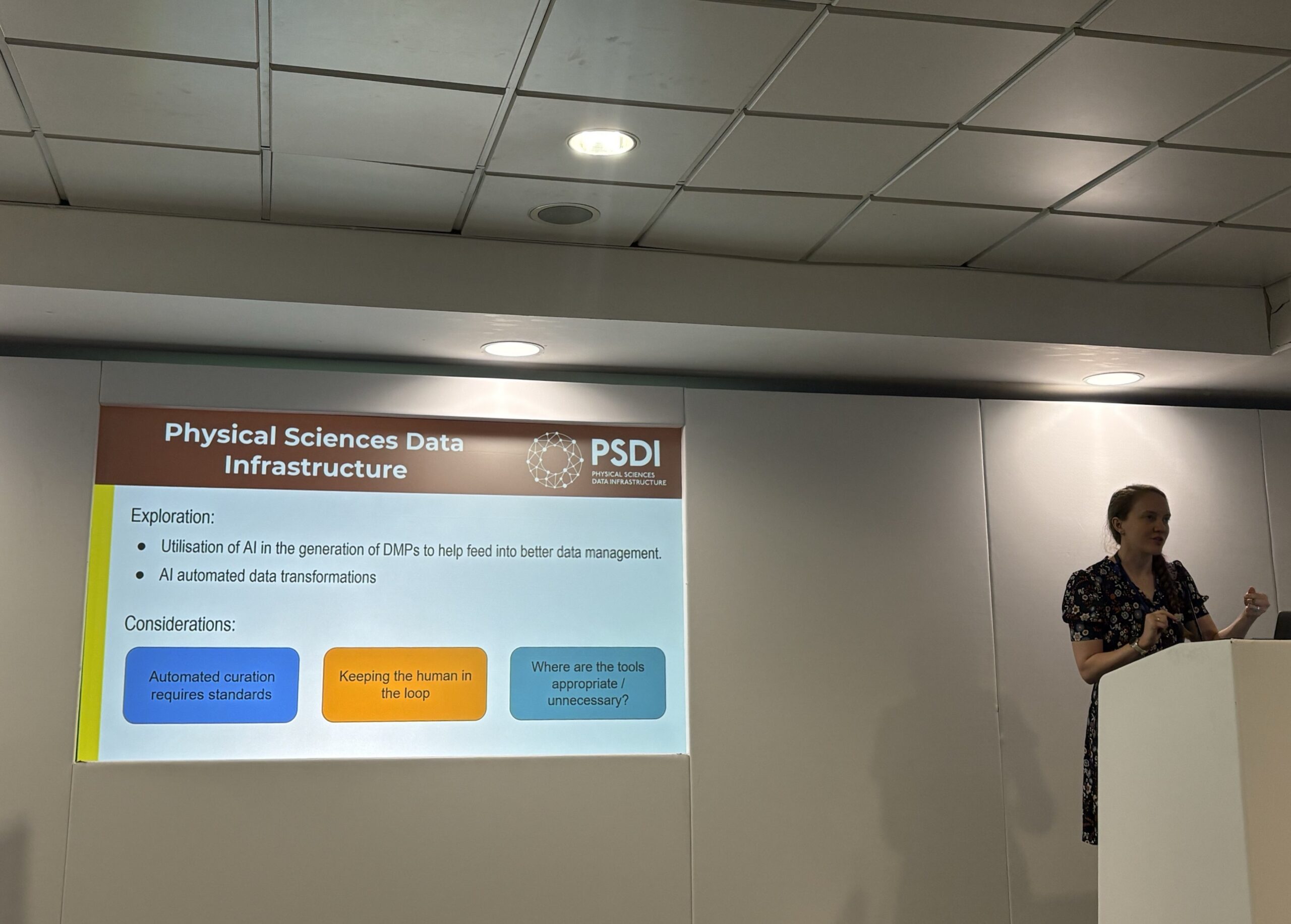
Dr Nicola Knight presenting during the harnessing automation and AI tools to advance data curation and connect digital research infrastructures Birds of a Feather session at RDA P27
- Oliver Koepler (TIB, NFDI4Chem) outlined the role of automation in creating machine-readable data and data annotation in NFDI4Chem, as well as in harvesting and ingesting data from the federated data repositories into the Chemistry Knowledge Graph. AI tools are being tested for tasks like data validation and quality control, terminology development and curation, data annotation, and querying Knowledge Graphs, always with human-in-the-loop.
- Ian Bruno (Cambridge Crystallographic Data Centre) traced a historical timeline of events in CCDC, from a fully manual curation of crystallographic data, through automated data ingest, to a largely automated curation workflow with human review and oversight, the transition driven in part by a rapid increase in the volume of data that made automation necessary. This includes an automated generation of chemical diagram indicating the chemical entities in the crystal structure, which is essential for data discovery and reuse. AI/ ML are explored in areas such as: data extraction from articles and patents (permissions allowing); metadata enrichment, particularly linking information from other sources; as well as data integrity and anomaly detection.
- Nicola Knight (Physical Sciences Data Infrastructure) spoke about automated workflows for metadata generation and the ingest of data from external sources in the context of PSDI data collections, with human oversight to supplement the rule-based automation. She highlighted one AI-based tool in the PSDI portfolio — the Data Revival Tool — which extracts scientific information from hand-written lab notes by ingesting unstructured image data and outputting structured digital content.
The discussion following the talks tackled topics including how to distinguish workflows suitable for automation from those truly requiring AI tools, balancing generalist vs. domain-specific solutions, and managing the risks via ethical guidelines and practical guardrails. We also explored joining new or existing RDA groups to continue this work. Please go to the session page to see the collaborative meeting notes if you couldn’t make the session and want more details.
With thanks to all contributors, including special thanks to additional presenters, Nicky Garland from Archaeological Data Service and Rory Macneil from ResearchSpace (RSpace)
Original post by Agnes Jasinska on LinkedIn, edited for publication here with permission