
When it comes to open data in organic chemistry, the answer appears to be: not really - at least, not yet.

Dr Sally Bloodworth
In a recent study published in the Beilstein Journal of Organic Chemistry, Dr Sally Bloodworth, Dr Cerys Willoughby, and Professor Simon J. Coles from the University of Southampton analysed 240 papers from 12 leading journals to examine how well researchers are adhering to FAIR (Findable, Accessible, Interoperable, Reusable) data practices. The findings were clear: while most authors meet the standards required of them by journal guidelines, very few go beyond them to follow recommended best practices.
Only 1% of papers shared original nuclear magnetic resonance (NMR) data – despite NMR being one of the most common techniques used to determine the structure of chemical compounds. In fact, across the entire study, there were no standout examples of truly open data sharing.
So, what’s holding researchers back? According to Sally, it’s not reluctance – it’s time. With chemists juggling grant applications, teaching, and lab supervision, there’s little incentive to go the extra mile when journals don’t require it.
“Researchers aren’t resistant to change,” she explains. “They’re just busy.”
The study was driven by a frustration Sally experienced years ago when trying to build on a published method — only to find crucial details missing. “I had to spend a lot of time re-learning the lessons that had enabled another research group to be successful, in order to make progress myself,” she recalls. “That is probably the point at which I began to think more about the importance of open data in chemistry.”
There is a strong case for researchers sharing their data. Open data doesn’t just make life easier for other chemists – it can accelerate discovery through secondary analysis of the data using machine-learning methods. Sally cites a recent example where a graph neural network – a type of computer model that learns by looking at how different pieces of information are connected – was trained on a relatively small dataset, predicted the outcomes of over 3,000 reactions.
“Now just imagine how long it would take to have tested those 3000 reactions in the laboratory!”she notes.“It would requiremonthsof discovery work for a well-equipped industrial lab and would be impossible to achieve in a smaller academic lab – it justwouldn’tbe done. The new discovery relied entirely on themachine-learning (ML) technique. Nowit’sgreat when a research group has the capacity to apply ML to their own dataset, but otherwise researchers can make their data openly available for re-analysis by others.”
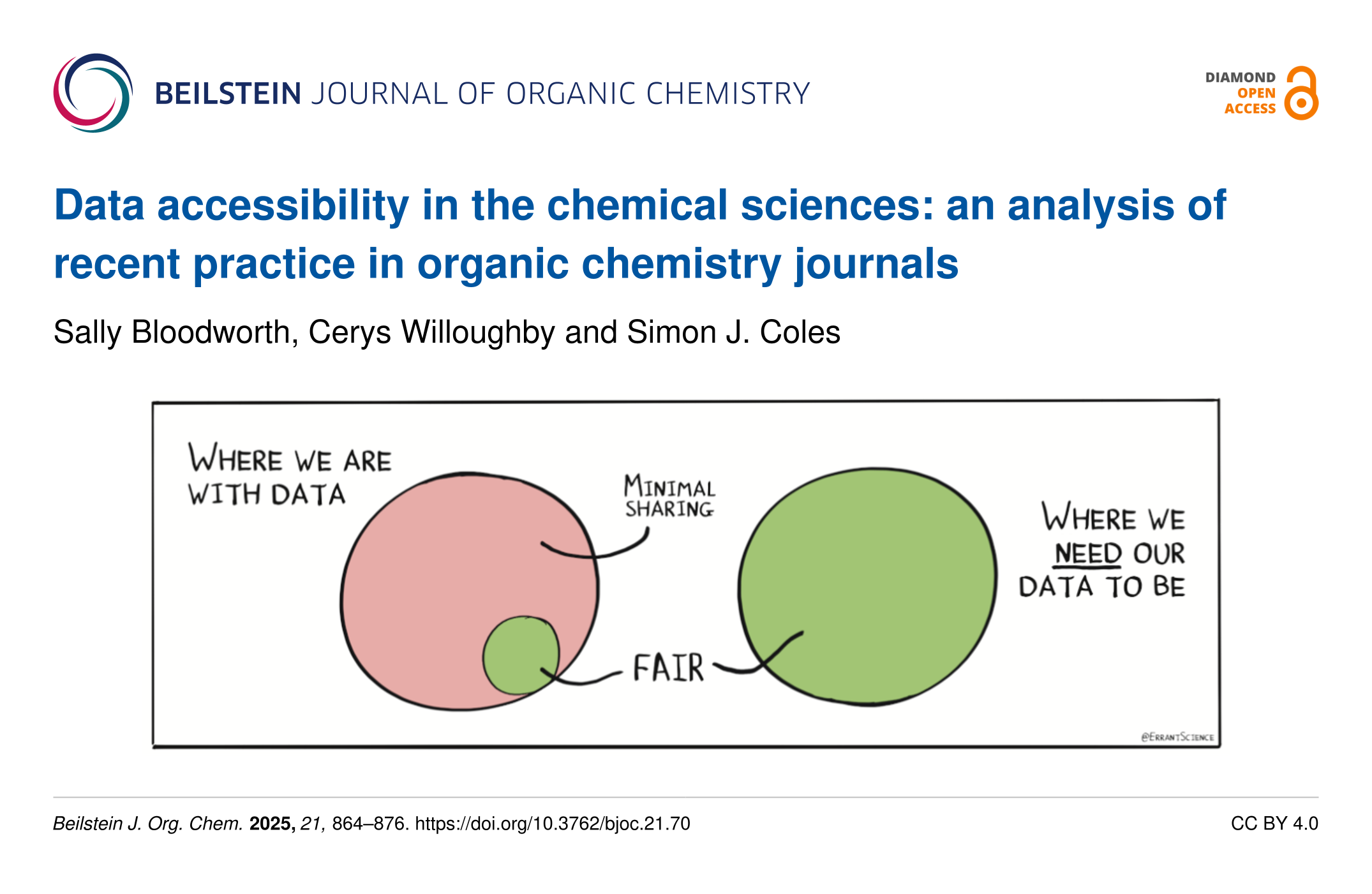
Of course, building this kind of data-enabled future requires more than just vision. There are still major cultural and systemic barriers in place. One of them is the way we perceive other researchers in our area.
“In the past, we have been rather trapped by the idea that researchers are often in competition with each other for funding, rather than in collaboration,”Sally explains. “But the importance of collaboration has grown hugely during my career, and this will naturally lead to a culture that is more open to sharing.”
So, what would help accelerate that change? Sally believes one of the most impactful – and achievable – steps would be requiring raw NMR data in its original form (known as FID files) along with clear chemical identifiers. These identifiers, such as SMILES (Simplified Molecular Input Line Entry System) or InChIs (International Chemical Identifiers), allow data to be easily read and interpreted by both humans and machines. “It would be a modest change for journals, but it would engage a huge portion of the community – everyone uses NMR!”she says.“The resources to support authors already exist; it’s an achievable step.”
Shifting the culture of chemistry towards openness will require more than just good intentions. Sally believes that systems of recognition and reward will be key. “In the same way that publishing high-quality papers in leading journals influences a researcher’s career development and ability to win funding, a system of recognising data sharing could also lead to those opportunities.”
Initiatives like the Physical Sciences Data Infrastructure (PSDI) are working to bridge the gap, developing tools and standards that make FAIR data easier to achieve — and supporting researchers to get there.
“If we want organic chemistry to embrace open data, we need systems that reward it and resources that support it. PSDI will be incredibly important in this objective.”
And to any organic chemists still on the fence about data sharing? Sally offers this encouragement:
“Even if you have no interest in using automated methods yourself, there will almost certainly be someone in your field who is. If you make your data available, you’re creating an opportunity for new discoveries – and you might even gain a new collaborator or citation in the process.”
So, are chemists sharing their homework? Not yet. But the groundwork is being laid — and with collaboration, consensus, and the right support, change is coming.
📖 Read the full paper: https://www.beilstein-journals.org/bjoc/articles/21/70
🔗 Learn more about PSDI and its work to support FAIR data in physical sciences: https://psdi.ac.uk