
Author: Dr Matthew Partridge
Built on years of hands-on experience, a new PSDI whitepaper offers chemistry labs a practical route from choosing an electronic laboratory notebook to keeping it useful for the long haul.
Moving from paper lab books to an electronic laboratory notebook sounds simple enough: choose some software, create a few accounts and let the researchers get on with it.
Anyone who has actually tried it will know there is more to the story.
Our new whitepaper, ELNs in Chemistry: From Implementation to Sustainable Stewardship, takes an honest, practical look at what it takes to introduce an electronic laboratory notebook, and make the change stick.
The report is written by Dr Samantha Pearman-Kanza, Principal Enterprise Fellow and PSDI’s Pathfinder Lead for Process Recording, and Dr Matthew Partridge, a Senior Enterprise Fellow specialising in chemistry data and digital infrastructure. Both are based at the University of Southampton’s School of Chemistry and Chemical Engineering.
Between them, the authors have spent years working where laboratory practice, research data and digital technology meet. Their experience stretches across several institutions and projects, from Southampton’s early LabTrove work to PSDI research into digital process recording.
Just as importantly, the guidance has been shaped by the people who have to make ELNs work in real life. That includes researchers using them at the bench, supervisors reviewing experiments, data stewards thinking about FAIR data, developers building the systems and providers supporting their deployment. For example, the authors consulted with Merck, ELN Finder and the developers of AI4Green ELN at the University of Nottingham.
The immediate catalyst was the trial and subsequent rollout of an ELN across the University of Southampton’s School of Chemistry and Chemical Engineering. The School’s first full, school-wide deployment involved selecting and testing a platform across varied areas of chemistry, then working through the less glamorous – but absolutely vital – questions of permissions, templates, metadata, hardware, training, support and long-term ownership.
That experience reinforced one of the whitepaper’s central messages: an ELN is not another software purchase. Once it becomes the main home for experimental records, it is part of a department’s research infrastructure. It needs to suit the way experiments are actually performed, rather than forcing every research group into a neat and tidy, but unrealistic, workflow.
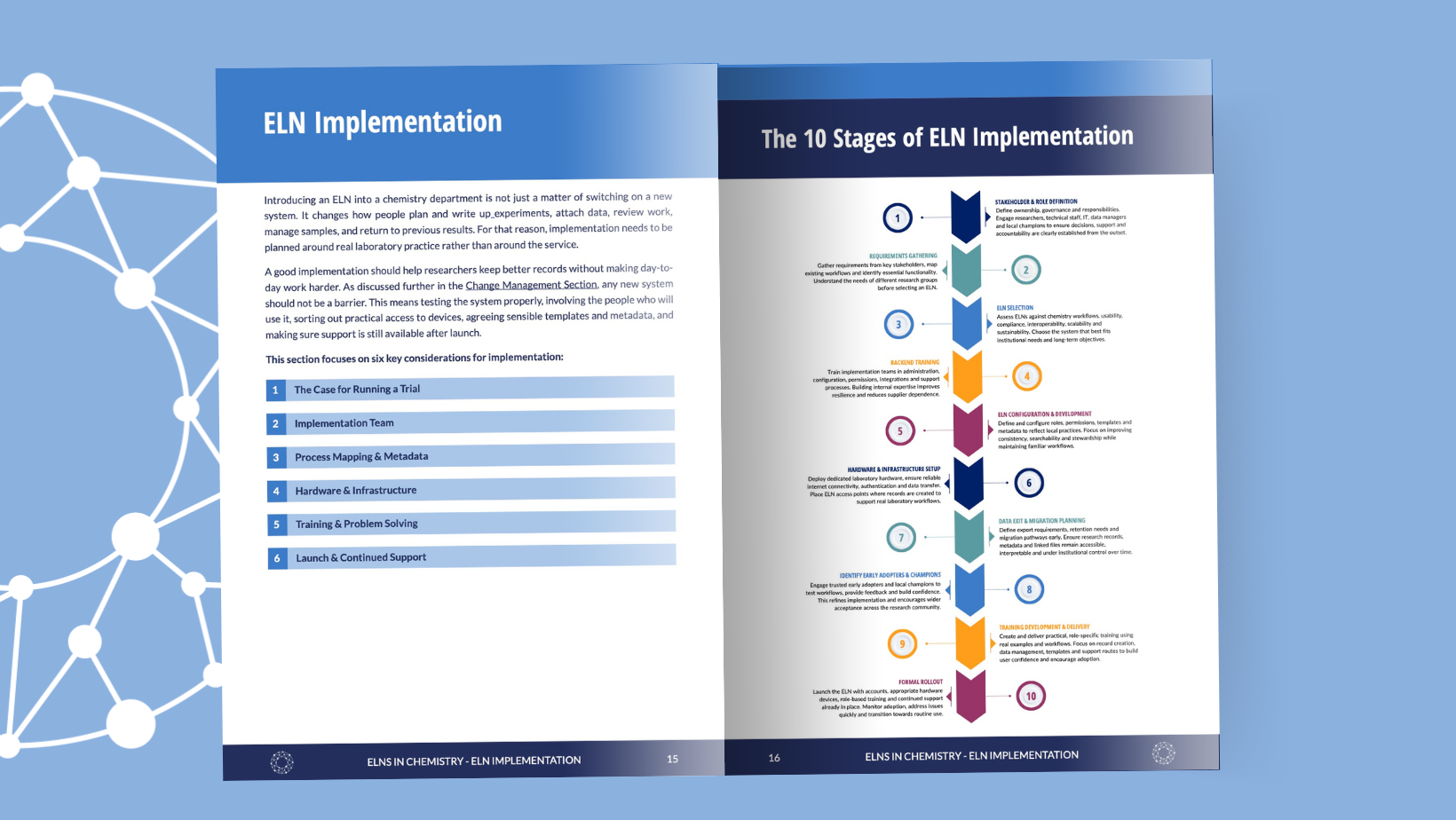
The whitepaper follows the whole ELN journey. It begins with selection, covering compliance, data integrity, functionality, accessibility, interoperability, scalability and the true lifetime cost of a system. It then moves into implementation, including why departments should run a realistic trial, who needs to be involved and why Wi-Fi, laboratory hardware and file handling should be tested at the bench rather than assumed to work.
There is also a deliberate and substantial focus on people. Clear governance, useful training, honest communication and visible routes for support all matter if an ELN is to become part of everyday research instead of feeling like an extra administrative task that adds to an already busy workload.
Finally, the whitepaper looks beyond launch day. Storage will grow, staff will move on, suppliers and products will change, and guidance will need updating. Departments therefore need sustained ownership, realistic budgets and an exit strategy that allows them to retain a complete, accessible and understandable scientific record if they ever change systems.
Those likely to get the most from the whitepaper include heads of schools and departments planning digital-research strategy, laboratory managers and technicians responsible for day-to-day workflows, and data stewards or research-data managers concerned with metadata, preservation and governance. Researchers, supervisors, IT teams and procurement staff involved in an ELN project will also find plenty of practical questions worth asking.
The aim is not to present any approach as a rigid recipe. Chemistry departments differ enormously in their research, instruments, working practices and existing infrastructure. Instead, PSDI hopes the whitepaper will provide a reusable template: something other departments and institutions can adapt when selecting, trialling, deploying and sustaining an ELN of their own.
Published under a CC-BY licence, the whitepaper is accompanied by a reusable slide deck and ELN selection checklist.